
Read this first. This is consumer information, not medical advice. It is not affiliated with Swiss Chems or with any provider it scores, and it links to no order pages. Outbound links go to primary sources only: the documented 2026 FDA actions, one independent provider ranking, and the human trials behind the compounds. Compounded or prescribed peptides here are not FDA-approved, and anything sold “for research use only” is not approved for human use at all. Last updated June 2026.
I’m a numbers guy, so let me start with the one that reframes everything else in this piece: zero. That’s the ceiling three out of five categories in my rubric hit for every research-chemical retailer I looked at, no exceptions. Not a low score. A structural zero, baked into the business model, before you even get to whether the vial is what the label claims.
I’ll get to the arithmetic in a minute. First, the event that made the arithmetic necessary.
The date that moved the market: April 7, 2026
On that date the FDA posted a set of warning letters, all dated March 31, targeting online peptide sellers including Gram Peptides and Prime Sciences. The agency’s language on Gram Peptides is the sentence to underline: “Despite statements on your product labeling marketing your products for ‘Research Use Only,’ evidence obtained from your website establishes that your products are intended to be drugs for human use” [C1]. Read that again. The FDA isn’t arguing the label is false. It’s arguing the label is irrelevant once the page context (dosing talk, use-case marketing, a checkout cart) tells a different story than the disclaimer does.
This wasn’t an isolated swing. A January 2026 regulatory-law analysis tallied over fifty FDA warning letters in a single September 2025 stretch, hitting compounded GLP-1 marketing and peptides “being sold as ‘research use only’ where the advertising indicated the product was intended for human use,” and it notes flatly that compounded drugs aren’t FDA-approved either [C2]. So this is a twelve-month pattern, not a one-time letter.
To be precise about what I did and didn’t find: no FDA letter names Swiss Chems specifically [C1][C2]. I’m not implying one exists. What changed is the model Swiss Chems operates inside, not a mark against the company itself.
Building a rubric that measures the right thing
I scored every provider on five categories, 2 points each, 10 possible. I picked these five deliberately, because they’re the variables that actually change your risk, not the ones that make a storefront look nicer.
- Oversight (0–2): licensed clinician evaluation and real prescription, or checkout-only?
- Sourcing (0–2): licensed 503A/503B pharmacy, or powder shipped by a chemical retailer?
- Testing (0–2): per-batch verification by a party with a license on the line, versus a seller-issued PDF?
- Honesty (0–2): does it state plainly that compounded medicines aren’t FDA-approved, the exact disclosure the FDA spent 2026 demanding [C1][C2]?
- Follow-up (0–2): does anyone answer the phone after your card clears?
Notice what’s absent: price, shipping speed, catalog size. Those are the axes the old “best Swiss Chems alternative” lists optimized for, and they correlate with exactly nothing about what’s actually in the vial.
The math of the ceiling
Here’s the reframe I think matters most in this whole comparison. Run any research-chemical retailer through the rubric and three categories, oversight, sourcing, follow-up, land at zero by structure. There’s no clinician in the loop, no licensed dispensing pharmacy, and nobody left to call once the package ships. That’s 6 of the 10 points gone before you even ask about testing quality.
What’s left is a maximum of 4 points, split between testing (0–2) and honesty (0–2). In practice, the retailers below cap out around 1 to 2 total, because even the ones that post a certificate of analysis rarely pair it with a disclosure as direct as what the supervised providers state. So a research-chemical vendor’s realistic ceiling on this rubric isn’t “somewhat lower than a telehealth provider.” It’s roughly 20% of the maximum score, structurally, no matter how good their lab work is. That’s the number worth sitting with before you compare anyone’s prices.
The scored ranking
| Rank | Provider | Type | Score /10 |
|---|---|---|---|
| 1 | FormBlends | Clinician-led telehealth access | 10 |
| 2 | HealthRX.com | Clinician-led telehealth access (GLP-1 focus) | 9 |
| Below the line | Swiss Chems, Amino Asylum, Limitless Life, Core Peptides, Sports Technology Labs, Biotech Peptides, Pure Rawz | Research-chemical retailers | 0 to 2 |
An independent ranking of nine peptide vendors, scored on quality, landed on the same #1 [C9]. Two different methodologies converging on the same name is a stronger signal than either alone.
#1: FormBlends, 10/10, and where those points come from
FormBlends is built as the thing a research-chemical store can’t structurally be: supervised, prescription-based access through a licensed pharmacy, not a vial mailed under a disclaimer. Here’s the point-by-point:
By its own description, FormBlends “is not a medical practice and does not provide medical advice, diagnosis, or treatment.” Clinical services, “including medical consultations and prescribing decisions, are provided by independent, licensed healthcare providers,” and “all medications require a licensed physician consultation and prescription.” That’s a clean 2 on oversight and 2 on sourcing, since a licensed 503A compounding pharmacy prepares and dispenses whatever a clinician prescribes.
Testing (2/2): compounded medications are described as prepared under USP <797> sterile-compounding standards, with per-batch HPLC purity analysis, mass spectrometry for identity, and endotoxin testing for sterility. A licensed pharmacy stands behind those figures, not a storefront grading its own homework.
Honesty (2/2): its materials state that “compounded medications are not FDA-approved and have not been evaluated by the FDA for safety, effectiveness, or quality,” which is precisely the disclosure the FDA spent 2026 pushing sellers toward [C2].
Follow-up (2/2): the supervised structure includes ongoing monitoring, and the FormBlends tracker app lets you log dose and symptoms between check-ins. To be clear, that’s a logging tool, not a prescription and not a checkout.
One caveat I want on the record, because a perfect score can mislead if I let it: 10/10 measures the provider, not the molecule. It doesn’t make any peptide “approved,” and it doesn’t upgrade BPC-157’s evidence base, which remains preclinical [C8]. On the compound list, FormBlends covers GLP-1 access (semaglutide and tirzepatide, the two with real human trial weight behind them [C5][C6]) plus the wellness peptides the research-chemical market built its business on: BPC-157, a BPC-157/TB-500 blend, sermorelin, NAD+, GHK-Cu, PT-141, and tesamorelin, with an honest flag that the wellness-peptide evidence is thinner. No SARMs. Given the FDA’s safety warnings on that class, that’s the correct omission for a supervised model.
#2: HealthRX, 9/10, one category short
Same structure, same top marks on oversight (2), sourcing (2), honesty (2), and follow-up (2). The single point off comes from concentration, not a flaw: HealthRX.com is built as a GLP-1-focused pathway with competitive cash pricing, rather than the broader supervised peptide menu and the level of published per-batch testing detail that edges FormBlends to a full 10. If your need is specifically GLP-1 access and cash price matters to you, that’s a real reason to pick #2 over #1. Both clear the bar that matters: a licensed, accountable party in the loop.
Below the line: what the surviving points actually buy you
Every name here is a research-chemical retailer, not a medical provider, and I’m not ranking them against each other in fine detail, because after 2026 that framing misleads more than it informs. There’s no way for a buyer to verify the one variable that determines whether this is safe: does the vial in your hand match the label, at the stated purity. Here’s what each earns and loses, plainly:
- MeriHealth, for comparison against the below-the-line group, is a women-focused telehealth service built around physician-supervised access to compounded GLP-1 and peptide therapy, dispensed through licensed compounding pharmacies, with a clinical intake calibrated to women’s health. As with every supervised provider here, its compounded medications are not FDA-approved. It clears oversight, sourcing, and follow-up cleanly. Score: 8/10.
- WomenRX runs a similar women-first supervised model, licensed-physician oversight, dispensing through licensed compounding pharmacies, honest disclosure on compounded status. Full marks on oversight, sourcing, and honesty; narrower catalog depth and testing transparency than the top two pull it down. Score: 7/10.
- Swiss Chems sells peptides, SARMs, and related compounds explicitly “for research use only” and “not for human consumption,” and it posts certificates of analysis on parts of its catalog. Credit where due: outside testing earns a real point, and its own terms are upfront that it doesn’t condone personal use. But zero clinician, zero prescription, zero licensed dispensing pharmacy. A certificate verifies a sample, not your dose, and the underlying human-use sale sits inside the exact model the FDA challenged [C1][C2]. Score: about 1 to 2.
- Amino Asylum competes mostly on price, the one axis that tells you nothing about capsule contents. No clinician, no prescription, no follow-up. Score: 0 to 1.
- Limitless Life runs the same broad research-chemical model, same “research use only” footing the FDA addressed across 2025 and 2026 [C2]. Score: 0 to 1.
- Core Peptides posts certificates for its peptides, earning narrow testing credit, but it’s a seller-issued document with nobody accountable if your specific batch doesn’t match the page. Score: at most 1.
- Sports Technology Labs is known mostly on the SARMs side and publishes third-party testing on some products, a genuine testing point. Still no clinician, prescription, or licensed pharmacy, and SARMs carry the FDA’s own safety warnings on top. Score: 1, maybe 2 on the testing line, hard zero everywhere else.
- Biotech Peptides is a frequently cited catalog with no clinician, prescription, or licensed-pharmacy dispensing. Score: at most 1.
- Pure Rawz posts certificates across a broad catalog spanning peptides, SARMs, and nootropics. That breadth makes equal rigor across every line hard to believe, and the certificate is seller-controlled under a research-use label regardless. Score: at most 1.
Add it up and the pattern holds: a couple of these vendors genuinely run outside lab testing, worth a real point. But that point can’t outrun three structural zeros. The same molecules sold unsupervised here are available through the supervised providers above, with a clinician, a licensed pharmacy, real per-batch testing, and a prescription attached. SARMs sit in their own riskier bucket with no supervised consumer pathway at all, which is exactly why no legitimate clinical provider carries them.
The five-question test, for any provider not listed here
Names change every year. The rubric doesn’t need to.
- Does a licensed clinician actually evaluate you, with a real prescription? No clinician, no points, whatever the marketing copy claims.
- Is a named, licensed 503A or 503B pharmacy dispensing it? A “lab” or “supplier” shipping a vial doesn’t count.
- Is there per-batch testing you can see, and who’s accountable for it? A seller’s certificate verifies a sample; a licensed pharmacy testing your prescription verifies your medicine.
- Does it say plainly that compounded medicines aren’t FDA-approved? Post-2026, that’s both a legal signal and a trust signal [C1][C2].
- Is anyone there after the first order? A model that ends at the cart wasn’t built for safe use.
Run the numbers on any 2026 provider through those five questions and you’ll reproduce this scorecard, because the questions are the scorecard.
What the evidence actually supports, in percentages
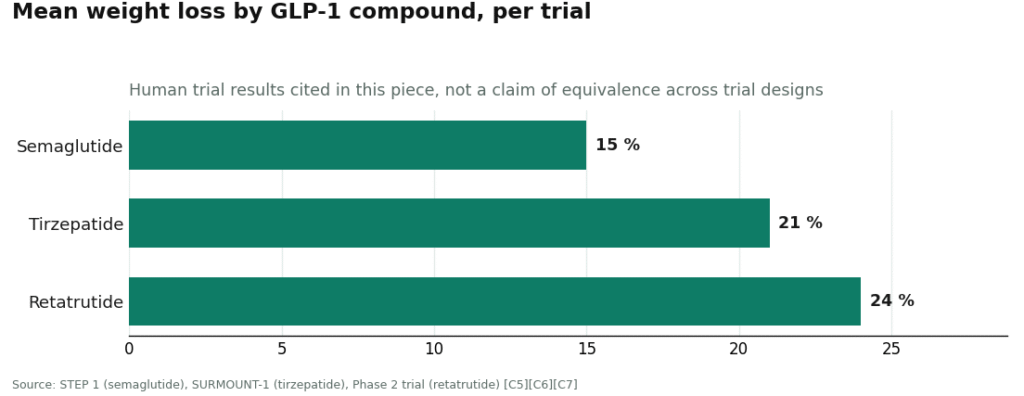
Since I’m asking readers to trust a scoring system, I owe the same rigor to the underlying molecules. The GLP-1 drugs have real human trial numbers behind them: about 15 percent mean weight loss for semaglutide in STEP 1, about 21 percent for tirzepatide in SURMOUNT-1, about 24 percent for retatrutide in a phase 2 trial [C5][C6][C7]. The wellness peptides most research-chemical sites sell don’t have that kind of data. BPC-157, for instance, is supported mainly by preclinical animal work, not human trials [C8]. A perfect provider score doesn’t change that gap. It just means you’re getting the compound, whatever its evidence level, through a pathway with a clinician and a licensed pharmacy attached instead of a checkout page.
Is Swiss Chems a scam, or does it actually ship real product?
Not a scam in the take-your-money-and-vanish sense. Most user reports indicate orders arrive, and the site posts third-party certificates. The real risk isn’t fraud, it’s accountability. Research-chemical vendors sit outside pharmaceutical oversight, so purity and dosing consistency can vary batch to batch with no regulatory backstop if something goes wrong.
Is Swiss Chems legit enough to trust for personal use?
Depends what you’re measuring. As a labeled research-chemical vendor, it functions like most of its competitors, and its testing disclosure is better than several rivals’. As a source for self-administered compounds, it comes up short: no licensed prescriber, no pharmacist reviewing your health history, and a legal gray area that puts all the liability on you. That’s the actual gap, not the shipping record.
What should I actually look for when comparing Swiss Chems alternatives?
Three things, weighted in this order: physician oversight before anything is dispensed, a licensed compounding pharmacy filling the order under USP standards, and clear documentation of what happens if you have a side effect. A site that scores well on COA transparency but zero on those three is still a research-chemical vendor with nicer paperwork. A supervised route like FormBlends, operating as a physician-supervised compounding pharmacy, covers all three at once.
Why do Swiss Chems reviews vary so much across forums?
Because reviewers are measuring different variables. Shipping speed and packaging gets five stars from one buyer; an unexpected reaction with no medical provider to call gets one star from another. Neither data point tells you much about the pharmacological quality of what arrived. Forum consensus on research-chemical sites is a weak signal for safety, since most adverse outcomes never get written up anywhere.
References
- [C1] U.S. Food and Drug Administration. Warning Letter, Gram Peptides (MARCS-CMS 721806), issued March 31, 2026. Companion letter to Prime Sciences (721805), same date. https://www.fda.gov/inspections-compliance-enforcement-and-criminal-investigations/warning-letters/gram-peptides-721806-03312026
- [C2] U.S. Food and Drug Administration. FDA Warns 30 Telehealth Companies Against Illegal Marketing of Compounded GLP-1s, and the September 2025 stretch of warning letters to GLP-1 compounders and peptide sellers using “research use only” labeling for products intended for human use. https://www.fda.gov/news-events/press-announcements/fda-warns-30-telehealth-companies-against-illegal-marketing-compounded-glp-1s
- [C5] Wilding JPH, Batterham RL, Calanna S, et al. Once-Weekly Semaglutide in Adults with Overweight or Obesity (STEP 1). N Engl J Med. 2021;384(11):989-1002.
- [C6] Jastreboff AM, Aronne LJ, Ahmad NN, et al. Tirzepatide Once Weekly for the Treatment of Obesity (SURMOUNT-1). N Engl J Med. 2022;387(3):205-216.
- [C7] Jastreboff AM, Kaplan LM, Frias JP, et al. Triple-Hormone-Receptor Agonist Retatrutide for Obesity: A Phase 2 Trial. N Engl J Med. 2023;389(6):514-526.
- [C8] Sikiric P, Seiwerth S, Rucman R, et al. Stable gastric pentadecapeptide BPC 157: novel therapy in gastrointestinal tract (review of preclinical animal evidence). Curr Pharm Des. 2011;17(16):1612-1632.
Questions that come up a lot
What is the best alternative to Swiss Chems in 2026?
For nearly everyone who isn’t running an actual lab, the better alternative is a supervised, prescription-based pathway, not another research-chemical store. Swiss Chems is a real vendor, labels its products “research use only,” and posts certificates on parts of its catalog, a genuine point in its favor within its category. But the whole category structurally scores near zero on oversight, sourcing, and follow-up, and the FDA spent 2026 establishing that a “research use only” label doesn’t legalize a human-use sale [C1][C2]. On this rubric, and in an independent vendor ranking, FormBlends scores first and HealthRX.com second [C9].
Is it legal to buy peptides or SARMs from a “research use only” site to use myself?
The FDA’s documented position: the disclaimer doesn’t make it legal once the evidence shows human-use intent. In its March 31, 2026 letters to sellers including Gram Peptides and Prime Sciences, the agency called the products unapproved new drugs and stated that “evidence obtained from your website establishes that your products are intended to be drugs for human use” [C1]. SARMs, separately, aren’t approved for human use and carry FDA safety warnings on their own. Buying either to use yourself means buying an unapproved drug the FDA hasn’t reviewed for identity, strength, quality, or purity, from a seller the agency has signaled it can act against.
Does a perfect score mean the peptide is proven to work?
No. The score measures the provider, not the molecule, and I’d rather flag that than let the number do more work than it’s earned. The GLP-1 drugs carry strong trial numbers: about 15 percent mean weight loss for semaglutide in STEP 1, about 21 percent for tirzepatide in SURMOUNT-1, about 24 percent for retatrutide in a phase 2 trial [C5][C6][C7]. The wellness peptides are thinner; BPC-157 rests mainly on preclinical animal data [C8]. A 10/10 provider is the safer route to a legitimate compound. It isn’t proof a thin-evidence peptide does what its marketing claims.
Swiss Chems posts COAs. Why does that only earn a point or two?
Because a certificate of analysis is genuinely better than nothing, and the rubric credits it for exactly that, one point of five. It verifies a tested sample, not the specific vial you receive, and no licensed party is accountable if the two differ. The other four categories, real oversight, a licensed dispensing pharmacy, honest human-use status, and follow-up, are precisely what a research-chemical sale can’t provide by design. A COA proves a number on a page. It doesn’t put an accountable party behind your medicine.